
Makurdi 2026
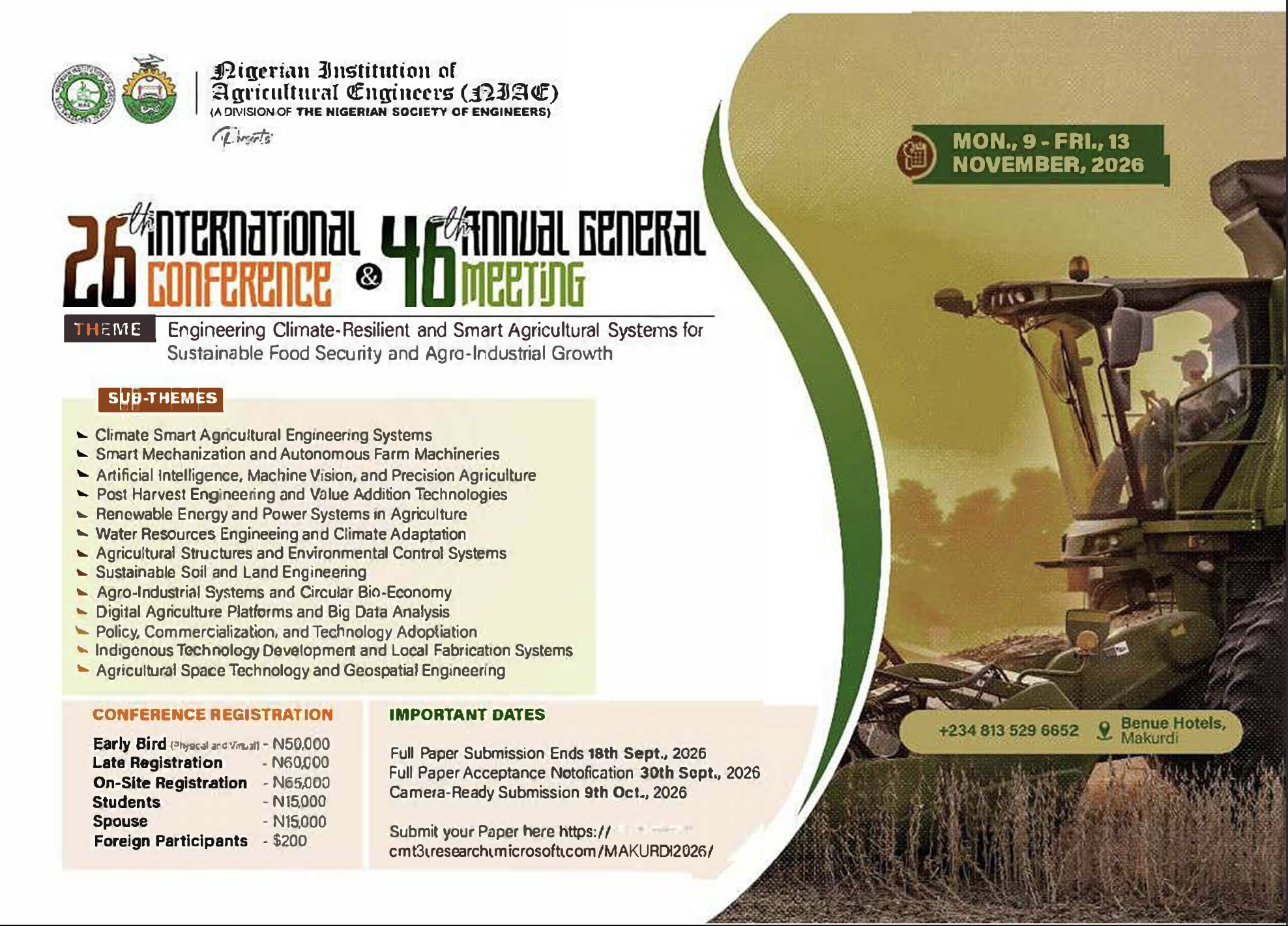
26TH INTERNATIONAL CONFERENCE AND 46TH ANNUAL GENERAL MEETING OF THE NIGERIAN INSTITUTION OF AGRICULTURAL ENGINEERS (NIAE)
GUIDE FOR AUTHORS
The announcement is an invitation to all interested participants to the 2026 NIAE International Conference, Makurdi 2026. Original papers on research findings related to the main and sub-themes are invited.
The manuscript should be prepared using double line spacing, Times New Roman and font size 12. Referencing is preferred in APA 7 style. All abstracts must be submitted with proof of Abstract processing fees of N5,000.00 only. Full manuscript must not exceed 17 pages.
Deadlines:
📍 Abstract Submission: 12nd May 2026 to 6th August 2026
📍 Full Paper Submission: 18th September 2026
📍 Full Paper acceptance notification: 30th September 2026
📍 Camera-Ready Submission: 9th October 2026
Organisation of the Manuscript
Divide the manuscript into clearly defined and numbered sections as follows. Abstract, Introduction, Materials and Methods, Results, Discussion, Conclusions and References.
Subsections should be numbered 1.1 (then 1.1.1, 1.1.2, 1.1.3, etc.). The abstract is not included in the section numbering. The following details are expected for each clearly defined section. For subheadings, the first letter of every word should be capitalised.
Title: The title should be as short as possible, usually not more than 17 words. Use words that can be used for indexing. In the case of multiple authors, the names should be identified with superscripted numbers and the addresses listed according to the numbers, eg. J. O. Olaoye1 and C. A. Adamade2.
Abstract: A concise and factual abstract is required of not more than 400 words. The abstract should state the purpose of the research, problem, a short outline of methods, the principal results and major conclusions briefly.
Introduction: State the objectives of the work and provide adequate background information on the problem, including recent or current references to work done by previous researchers. It should end with objectives and a contribution to the work. However, avoid a detailed literature survey or a summary of the results.
Materials and Methods: Provide sufficient details to allow the work to be reproduced. Methods already published should be indicated by a reference; only relevant modifications should be described.
Results: Results should be clear and concise. Results give details of what has been achieved, presented in descriptive, tabular or graphical forms.
Discussion: This should explore the significance of the results of the work, not repeat them. A combined Results and Discussion section is often appropriate. Discussion, on the other hand, describes ways the data, graphs and other illustrations have served to provide answers to questions and describe problem areas as previously discussed under the introduction. Avoid extensive citations and discussion of published literature
Conclusions. The main conclusions of the study may be presented in a short conclusion section, which may stand alone or form a subsection of a Discussion or Results and Discussion section
Notation: A list of symbols and abbreviations should be provided, even though each of them should be explained in the places where they are used.
Figures and Tables: Figures and Tables should be presented after citation within the text. Figures or Tables should be numbered by Arabic numerals, e.g. Figure 1, Table 2, in ascending order as reference is made to them in the text. Ensure that each illustration has a caption. A caption should comprise a brief life and description of the illustration. Number tables consecutively in accordance with their appearance in the text. Place footnotes to tables below the table body and indicate them with superscript lowercase letters. Avoid vertical lines. Use tables sparingly and ensure that the data presented in the table does not duplicate results described elsewhere in the article, either as a figure.
References: All references mentioned in the References. The list should be cited in the text and vice versa. Permission should be obtained for the use of copyrighted materials from other sources (including the Web). APA 7 referencing style is preferred.
To proceed with online submissions use the link below:
Full Name of the Conference: 26TH INTERNATIONAL CONFERENCE AND 46TH ANNUAL GENERAL MEETING OF THE NIGERIAN INSTITUTION OF AGRICULTURAL ENGINEERS (NIAE)
City: MAKURDI
Theme: Engineering Climate-Resilient and Smart Agricultural Systems for Sustainable Food Security and Agro-Industrial Growth
Sub-Themes
Climate Smart Agricultural Engineering Systems
Smart Mechanisation and Autonomous Farm Machineries
Artificial Intelligence, Machine Vision, and Precision Agriculture
Post-Harvest Engineering and Value-Addition Technologies
Renewable Energy and Power Systems in Agriculture
Water Resources Engineering and Climate Adaptation
Agricult1.1ral Structures and Environmental Control Systems
Sustainable Soil and Land Engineering
Agro-Industrial Systems and Circular Bio-Economy
Digital Agriculture Platforms and Big Data Analysis
Policy, Commercialisation, and Technology Adoption
Indigenous Technology Development and Local Fabrication Systems
Agricultural Space Technology and Geospatial Engineering
 Previous Post